
Reporting Correlation Synthesis and Factor Models
Synthesis-Factor-Report-Workflow.Rmdsynthesis_factor_report() collects pooled correlations,
matched uncertainty, between-study heterogeneity, factor results and
sensitivity diagnostics. Its tables distinguish descriptive results from
sampling-covariance-aware WLS.
Prepare the synthesis
set.seed(104)
loading <- c(.7,.8,.6,.9)
population_R <- tcrossprod(loading)
diag(population_R) <- 1
variables <- paste0("x",1:4)
pairs <- combn(variables,2)
pair_names <- paste(pairs[2,],pairs[1,],sep="_")
study_correlations <- lapply(1:20,function(i) {
  n <- 150+5*i
  x <- matrix(rnorm(n*4),n,4) %*% chol(population_R)
  values <- cor(x)[lower.tri(population_R)]
  out <- data.frame(ID=paste0("s",i),N=n)
  for(j in seq_along(values)) out[[pair_names[j]]] <- values[j]
  out
})
study_data <- do.call(rbind,study_correlations)
synthesis <- mars(study_data,studyID="ID",effectID="numID",sample_size="N",
  effectsize_type="cor",variable_names=pair_names,varcov_type="weighted",
  estimation_method="FE")
Each row represents an independent study correlation matrix. Pair
names identify matrix coordinates even if columns are reordered. Sample
sizes are aligned by study ID. Incomplete matrices retain observed pair
identities; completely unobserved pairs cannot be identified.
varcov_type="weighted" uses a sample-size-weighted common
correlation structure for the Olkin–Siotani sampling covariance.
average uses available-data means; simple uses
each study’s matrix with zeros for missing entries in the covariance
approximation.
This simulation has a common population matrix, so the example uses
common-effect synthesis (FE). For substantive
heterogeneity, select REML and assess the between-study
correlation covariance and the number of studies available to estimate
it. Neither raw-r means nor matrix repair guarantee a positive-definite
pooled matrix.
CFA report
report <- synthesis_factor_report(synthesis,factor_method="cfa",
  cfa_model="F =~ x1+x2+x3+x4",include_publication_bias=FALSE)
report$publication_tables$pooled_correlation
#>   var1 var2  pooled_r          se  ci_lower  ci_upper
#> 1   x1   x2 0.5630243 0.010732366 0.5419893 0.5840594
#> 2   x1   x3 0.3925544 0.013292052 0.3665025 0.4186064
#> 3   x2   x3 0.4569549 0.012432387 0.4325878 0.4813219
#> 4   x1   x4 0.6217887 0.009638318 0.6028979 0.6406794
#> 5   x2   x4 0.7287359 0.007368744 0.7142934 0.7431784
#> 6   x3   x4 0.5303767 0.011293290 0.5082422 0.5525111
report$publication_tables$factor_loadings
#>   factor indicator   loading standardized_loading standardized_se
#> 1      F        x1 1.0000000            0.6896097     0.009529765
#> 2      F        x2 1.1678547            0.8053640     0.007503149
#> 3      F        x3 0.8404668            0.5795941     0.011584333
#> 4      F        x4 1.3145066            0.9064965     0.006225806
#>   standardized_ci_lower standardized_ci_upper salient
#> 1             0.6709317             0.7082877    TRUE
#> 2             0.7906580             0.8200699    TRUE
#> 3             0.5568892             0.6022989    TRUE
#> 4             0.8942942             0.9186989    TRUE
report$factor_correlations
#>   F
#> F 1
report$fit_indices
#>   chi_square df    p_value       CFI       TLI RMSEA        SRMR
#> 1     4.7174  2 0.09454306 0.9997674 0.9993021    NA 0.006371705
Pooled correlation intervals are centered at the estimate and use its matched sampling standard error. They are pointwise normal approximations and can extend outside [-1,1]. Heterogeneity entries are between-study standard deviations, not sampling SEs. A common-effect synthesis has no estimated heterogeneity matrix.
CFA auto fitting uses WLS when matched covariance is available. Raw marker-scaled and standardized loadings are shown separately. Standardized loadings determine salient-loading flags; their uncertainty uses the same WLS expected information. A raw loading above one is not sufficient evidence of an inadmissible solution. Factor correlations refer to marginal latent covariances, including structural paths when present.
Actual study influence
report$plots$influence
#>    study frobenius_change max_abs_change estimable reason
#> 1     s1      0.016805296    0.006387620      TRUE   <NA>
#> 2    s10      0.007257671    0.003178492      TRUE   <NA>
#> 3    s11      0.007689987    0.004100557      TRUE   <NA>
#> 4    s12      0.006496317    0.003353728      TRUE   <NA>
#> 5    s13      0.011180362    0.005137506      TRUE   <NA>
#> 6    s14      0.007511833    0.003402378      TRUE   <NA>
#> 7    s15      0.007902221    0.003264201      TRUE   <NA>
#> 8    s16      0.003429055    0.001485602      TRUE   <NA>
#> 9    s17      0.005942801    0.002283365      TRUE   <NA>
#> 10   s18      0.005808004    0.002106284      TRUE   <NA>
#> 11   s19      0.011471586    0.004909974      TRUE   <NA>
#> 12    s2      0.008623344    0.004479106      TRUE   <NA>
#> 13   s20      0.009592835    0.006386144      TRUE   <NA>
#> 14    s3      0.004679781    0.001892955      TRUE   <NA>
#> 15    s4      0.006974724    0.003528457      TRUE   <NA>
#> 16    s5      0.004809898    0.002730318      TRUE   <NA>
#> 17    s6      0.004800167    0.002340611      TRUE   <NA>
#> 18    s7      0.004286792    0.002651874      TRUE   <NA>
#> 19    s8      0.007216461    0.003000434      TRUE   <NA>
#> 20    s9      0.005538855    0.002752505      TRUE   <NA>
plot(report,type="influence")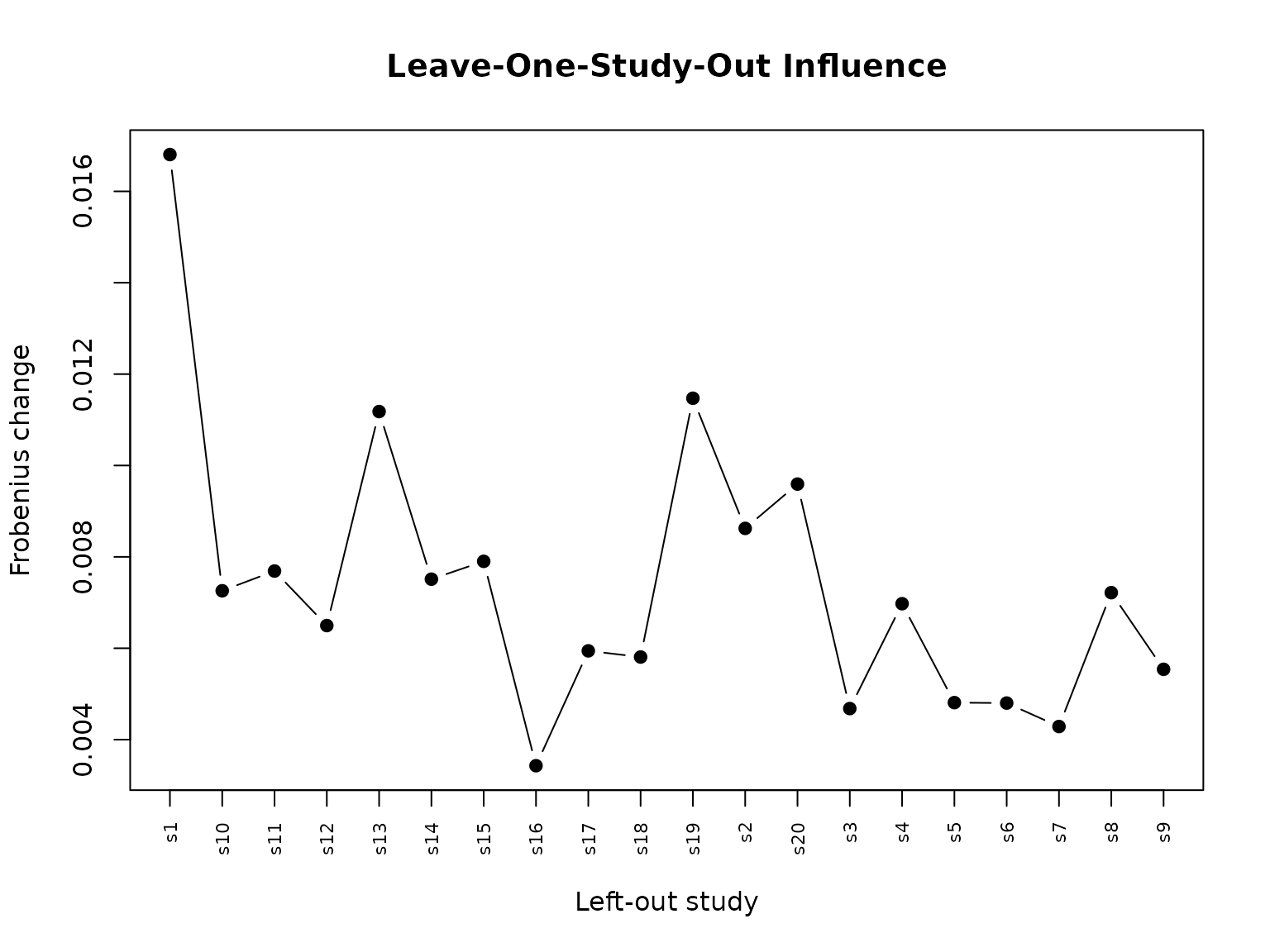
Each study omission refits the original synthesis specification. Average/weighted pooling is recomputed instead. The report preserves attenuation, missing-pair handling and matrix-repair choices. Frobenius change summarizes the whole matrix; maximum absolute change identifies the largest pair shift. These are sensitivity measures, not significance tests. Failed refits have NA shifts and explicit reasons. Objects lacking a stored refit specification have unavailable model-based influence rather than artificial zero changes.
EFA report and uncertainty
exploratory <- synthesis_factor_report(synthesis,factor_method="efa",n_factors=1,
  se_method="simulation",se_draws=100,se_seed=15,include_publication_bias=FALSE)
exploratory$publication_tables$factor_loadings
#>    indicator   Factor1 communality uniqueness  Factor1_se Factor1_ci_lower
#> x1        x1 0.6890976   0.4748555  0.5251442 0.010788707        0.6679521
#> x2        x2 0.8048354   0.6477600  0.3522398 0.006927553        0.7912577
#> x3        x3 0.5789499   0.3351830  0.6648171 0.012101309        0.5552318
#> x4        x4 0.9062313   0.8212552  0.1787448 0.006152533        0.8941726
#>    Factor1_ci_upper salient
#> x1        0.7102431    TRUE
#> x2        0.8184132    TRUE
#> x3        0.6026680    TRUE
#> x4        0.9182901    TRUE
exploratory$factor_fit$se_diagnostics
#> $method
#> [1] "simulation"
#>
#> $seed
#> [1] 15
#>
#> $attempted
#> [1] 100
#>
#> $accepted
#> [1] 100
#>
#> $rejected
#> [1] 0
#>
#> $success_rate
#> [1] 1
#>
#> $sufficient
#> [1] TRUE
#>
#> $source_bootstrap
#> NULL
#>
#> $alignment
#> [1] "Optimal permutation and sign matching"
EFA fits are descriptive. Oblique communalities and implied matrices
include the factor correlation matrix. Loading uncertainty conditions on
the selected factor count and rotation; factor permutations and signs
are matched across draws. Uniqueness-boundary flags and substantial
rotational instability need inspection. Parallel-analysis sensitivity
can be requested with factor_retention="parallel" and an
explicit parallel_n, but does not provide calibrated
factor-retention inference for synthesized correlations.
Alternative pooling and reliability correction
alternative <- synthesis_factor_report(synthesis,factor_method="cfa",
  cfa_model="F =~ x1+x2+x3+x4",synthesis_method="weighted",
  synthesis_transform="fisher_z",include_publication_bias=FALSE)
alternative$model_decisions
#> $synthesis_method
#> [1] "weighted"
#>
#> $synthesis_transform
#> [1] "fisher_z"
#>
#> $missing_corr
#> [1] "available"
#>
#> $attenuation
#> [1] "none"
#>
#> $reliability_missing
#> [1] "error"
#>
#> $pd_adjust
#> [1] "none"
#>
#> $pd_adjusted
#> [1] FALSE
#>
#> $vcov_source
#> [1] "model"
#>
#> $missingness_handling
#> [1] "remove"
alternative$publication_tables$pooled_correlation
#>   var1 var2  pooled_r se ci_lower ci_upper
#> 1   x1   x2 0.5651766 NA       NA       NA
#> 2   x1   x3 0.3933757 NA       NA       NA
#> 3   x2   x3 0.4584438 NA       NA       NA
#> 4   x1   x4 0.6235008 NA       NA       NA
#> 5   x2   x4 0.7304763 NA       NA       NA
#> 6   x3   x4 0.5318312 NA       NA       NA
alternative$factor_fit$se_note
#> [1] "Pooled-correlation uncertainty is unavailable for alternative pooling or a repaired matrix; the original estimator covariance cannot be reused."
Alternative pooling and repaired matrices do not have matched
sampling covariance in this workflow; uncertainty and synthesis-aware
global fit tests are withheld. Fisher-z pooling back-transforms before
matrix completion. missing_corr="em" is iterative matrix
completion, not likelihood EM. Reliability correction uses variable- and
study-specific reliability with explicit missing-value policies;
skip leaves the entire incomplete pair uncorrected. A
study’s missing reliability is not borrowed from another study.
Diagnostics and interpretation
plot(report,type="pooled_r")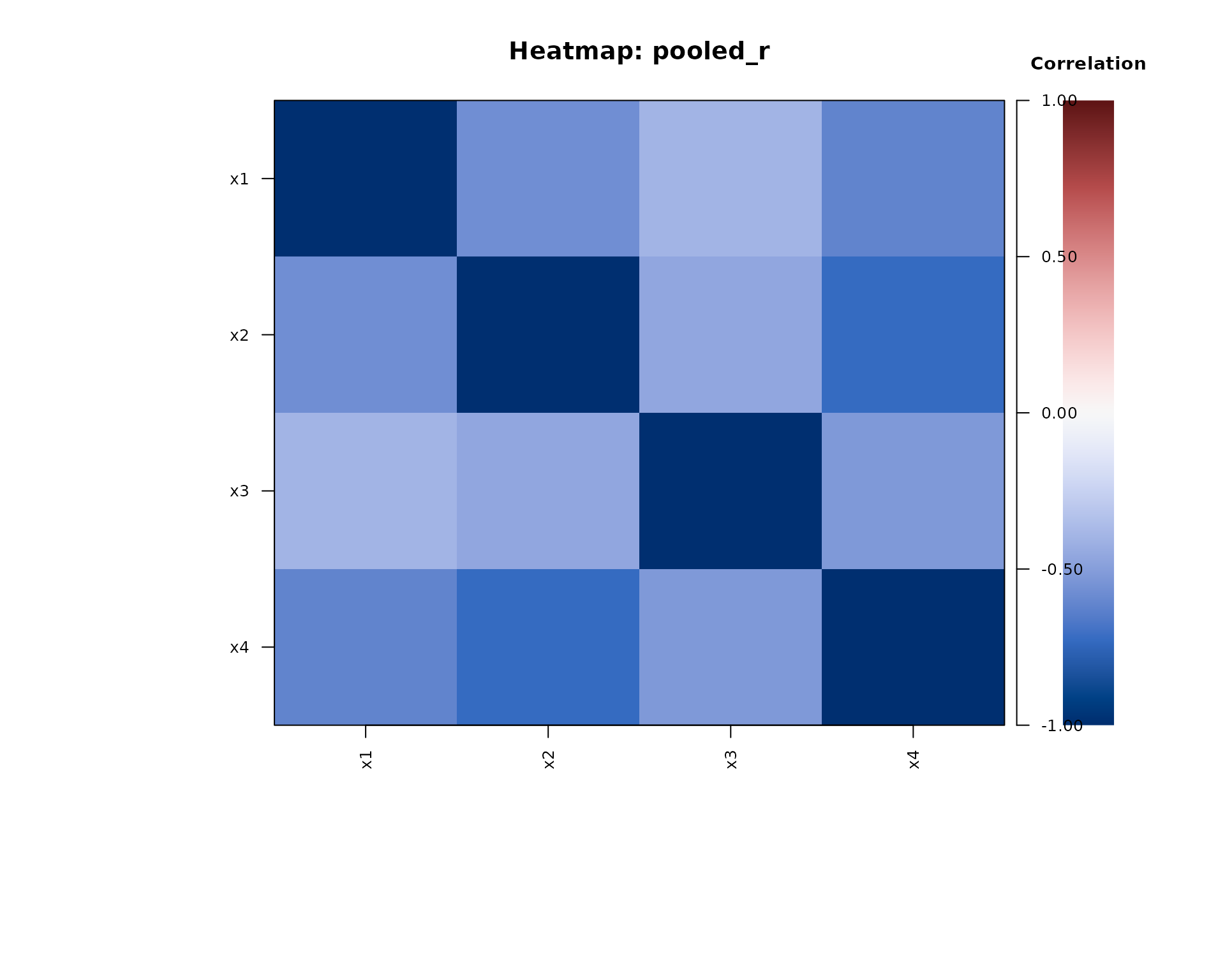
plot(report,type="residuals")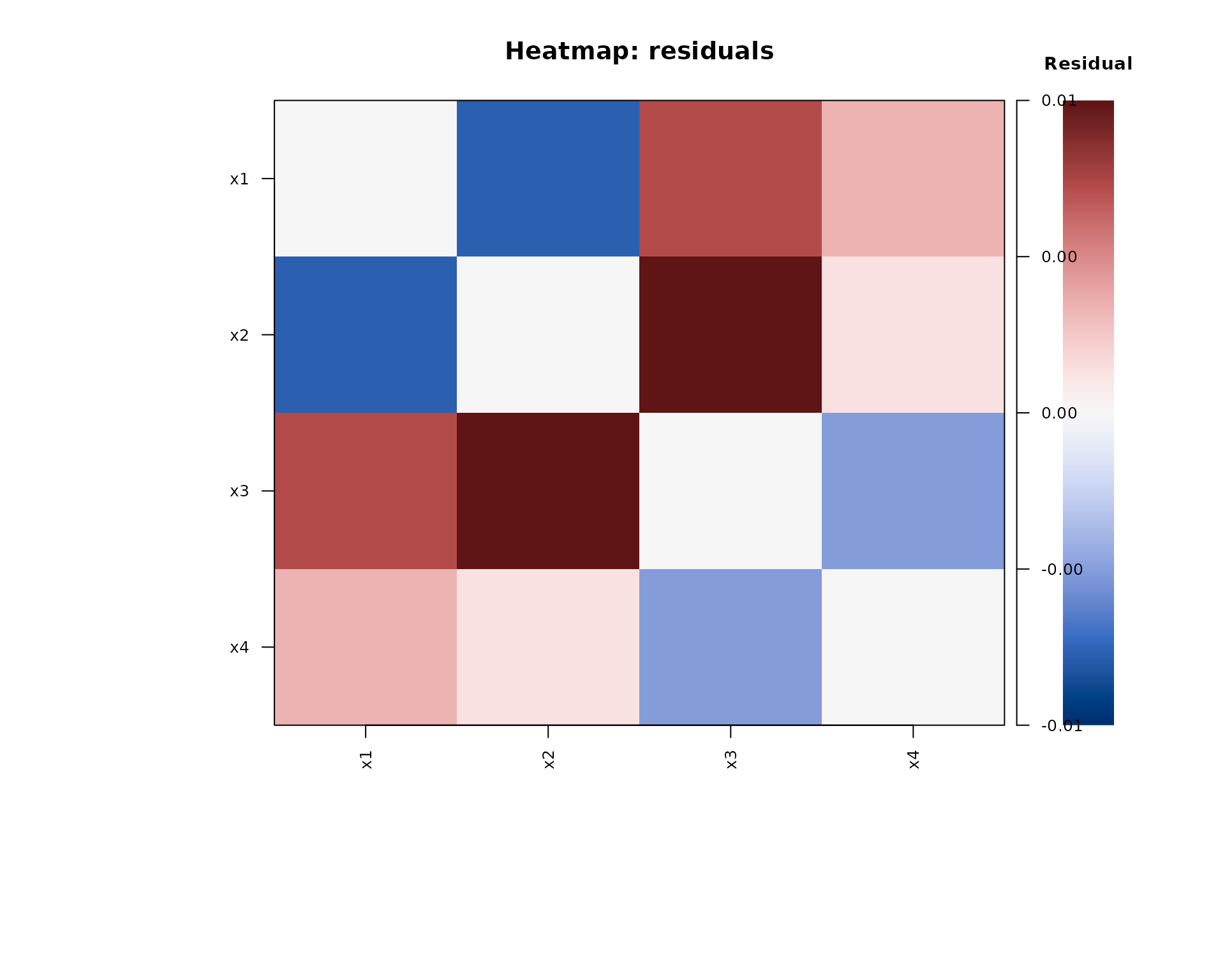
report$limitations
#> $factor_inference
#> [1] "CFA WLS inference uses the matched estimated correlation sampling covariance. Descriptive fits and EFA have no sample-size-based global fit tests. Alternative pooling/repair has no matched sampling covariance; its SEs and CIs are unavailable."
#>
#> $dependence_assumptions
#> [1] "Assumes modeled within-study dependence and random-effects structure are correctly specified for synthesized correlations."
#>
#> $small_study_publication_bias
#> [1] "Not assessed."
#>
#> $sensitivity_results
#> [1] "Leave-one-study-out max Frobenius change = 0.01681; max absolute cell change = 0.006388."
report$reproducibility
#> $call
#> NULL
#>
#> $package_version
#> [1] "0.6.0.8"
#>
#> $seed
#> [1] NA
#>
#> $convergence_warnings
#> character(0)
WLS global tests assume valid matched sampling covariance and sufficient independent studies. They condition on estimated covariance and heterogeneity. RMSEA is unavailable; SRMR describes residuals. EFA and descriptive CFA have no single-sample global fit tests. Simulation/bootstrap SEs require at least 50 accepted fits and an 80 percent acceptance rate. Seeds and failure counts are stored with the factor fit.
group_var returns an explanation that multi-group
invariance testing is unavailable. Valid invariance requires
group-specific synthesis and a joint shared-parameter model; descriptive
group comparisons do not provide such a test.
Publication-bias checks are optional exploratory diagnostics. Multiple correlation pairs may have different means and precision patterns. The check retains the original mean design and uses study-cluster inference; it does not establish selection or causality and requires sufficient independent studies.