
Profile Likelihood with MARS
mars authors
2026-09-10
Profile-Likelihood.RmdThis vignette shows the low-runtime profile-likelihood helpers in
mars. Profile likelihoods are useful when Wald intervals
for variance components are too symmetric or too dependent on the local
curvature at the optimum. The profile plots use the fitted model
objective on a deviance-like scale, so lower values indicate better fit
and chi-square cutoffs can be drawn above the fitted minimum.
Interpreting Profile Likelihoods
A profile likelihood plot is analogous to plotting the likelihood
directly, but on the optimizer’s deviance-scale metric. In this package,
lower values indicate better fit. For ordinary mars models,
the objective is equivalent to -2 log L up to constants
that do not change across the profile; for publication-bias profiles,
the same -2 log L scaling is used.
For a one-dimensional profile:
- The x-axis is the value of the parameter being held fixed.
- The y-axis is the deviance-scale objective after all other parameters have been re-optimized.
- The bottom of the curve is the best-supported value on the grid.
- The horizontal cutoff line is the fitted minimum plus
qchisq(level, df = 1). For a 95% profile interval, this is approximately 3.84 above the minimum.
For a two-dimensional profile surface, the x- and y-axes are two
parameters held fixed together. Each contour shows how much worse the
best possible model fit is after all remaining parameters are allowed to
adapt. The highlighted cutoff contour uses
qchisq(level, df = 2) above the fitted minimum and can be
read as an approximate joint confidence region for the parameter
pair.
Fit a Small Model
We use the bundled bcg data and fit a univariate
meta-regression. The examples below intentionally use small grids so the
vignette compiles quickly.
fit_bcg <- mars(
  formula = yi ~ year,
  data = bcg,
  studyID = "trial",
  variance = "vi",
  varcov_type = "univariate",
  structure = "univariate",
  estimation_method = "MLE"
)

summary(fit_bcg)
#> Results generated with MARS:v 0.6.0
#> Thursday, September 10, 2026
#>
#> Model Type:
#> univariate
#>
#> Estimation Method:
#> Maximum Likelihood
#>
#> Model Formula:
#> yi ~ year
#>
#> Data Summary:
#> Number of Effect Sizes: 13
#> Number of Fixed Effects: 2
#> Number of Random Effects: 1
#>
#> Random Components:
#>       term    var    SD
#>  intercept 0.2819 0.531
#>
#> Fixed Effects Estimates:
#>    attribute estimate       SE z_test p_value      lower    upper
#>  (Intercept) -53.2412 32.70445 -1.628  0.1035 -117.34072 10.85839
#>         year   0.0267  0.01662  1.606  0.1082   -0.00588  0.05928
#>
#> Model Fit Statistics:
#>  logLik  Dev  AIC  BIC AICc
#>   -12.7 35.4 31.4 33.1 53.8
#>
#> Q Error: 100.178 (11), p < 0.0001
#>
#> I2 (General): 89.2357
#>
#> Residual Diagnostics:
#>   n n_finite_raw mean_raw sd_raw   rmse    mae q_pearson mean_abs_studentized
#>  13           13 0.006114 0.6259 0.6013 0.5193     10.52               0.8597
#>  max_abs_studentized prop_abs_studentized_gt2 prop_abs_studentized_gt3
#>                1.974                        0                        0
#>
#> Normality (whitened residuals):                   test n_tested statistic p_value
#>  shapiro_wilk_whitened       13    0.8975  0.1237
#>
#> Heteroscedasticity trend (|raw residual| ~ fitted):   n corr_abs_raw_fitted  slope p_value
#>  13              0.3116 0.3369     0.3
One-Dimensional Profiles
profile_likelihood() can profile fixed-effect parameters
by name and random effect parameters as tau1,
tau2, and so on.
pr <- profile_likelihood(
  fit_bcg,
  parameters = c("year", "tau1"),
  n_points = 5,
  span = 2
)

pr$summary
#>   parameter parameter_index           mle   cutoff  ci_lower   ci_upper
#> 1      year               2 -0.0003590629 5.349309 -0.053254 0.05430397
#> 2      tau1               3  0.2819106893 5.349309        NA 0.98583762
Each profiled parameter has a data frame containing the fixed grid
value, the conditional deviance-scale objective value, and optimizer
convergence status. The objective column is the plotted
outcome; it is not the original effect-size outcome variable.
pr$profiles$year
#>   parameter parameter_index parameter_value objective converged
#> 1      year               2          -2e+00 92.531406      TRUE
#> 2      year               2          -1e+00 74.888767      TRUE
#> 3      year               2           2e-08  1.437747      TRUE
#> 4      year               2           2e-08  1.437747     FALSE
#> 5      year               2           1e+00 73.468648      TRUE
#> 6      year               2           2e+00 91.819622      TRUE
pr$profiles$tau1
#>   parameter parameter_index parameter_value objective converged
#> 1      tau1               3       0.1409553 -0.814914      TRUE
#> 2      tau1               3       0.2819107 -1.142022      TRUE
#> 3      tau1               3       0.2827391 -1.136381      TRUE
#> 4      tau1               3       0.5671398  1.619323      TRUE
#> 5      tau1               3       1.1376125  6.701402      TRUE
#> 6      tau1               3       2.2819107 13.415105      TRUE
The plot method draws a profile curve and invisibly returns the data frame used for the plot.
plot(pr, parameter = "year")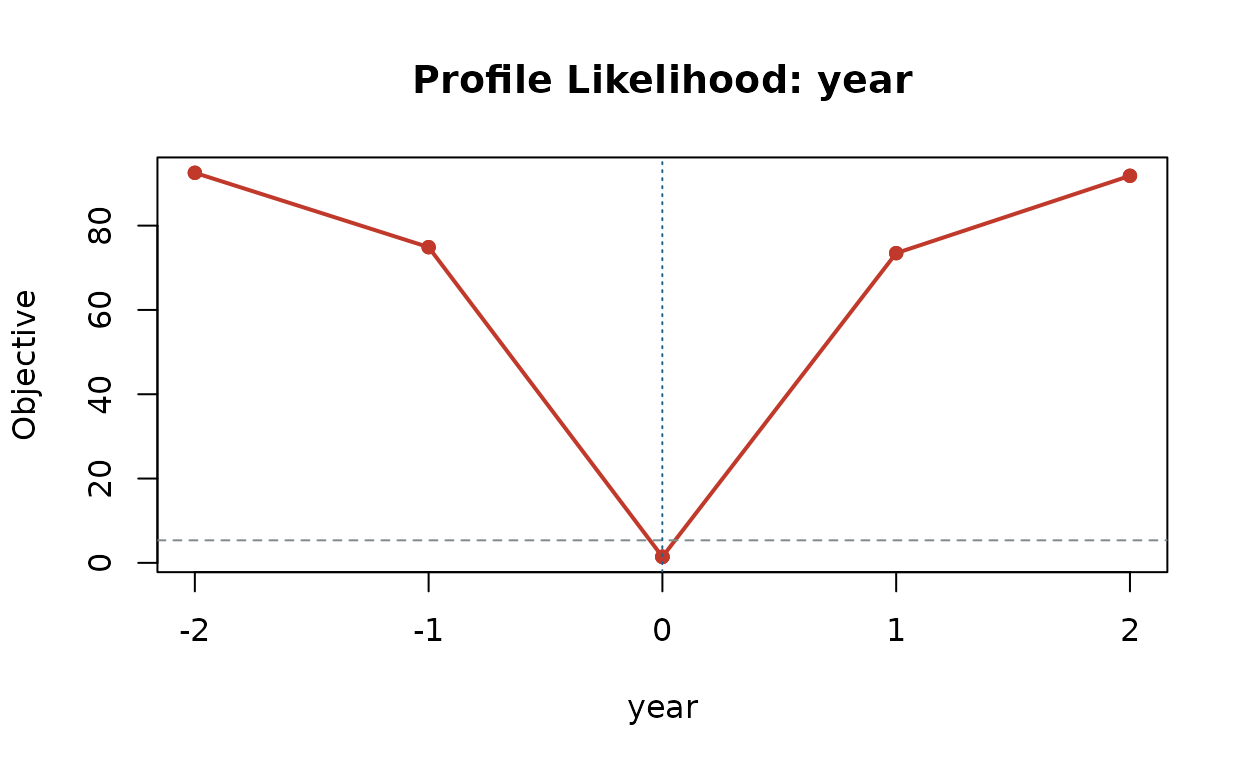
plot(pr, parameter = "tau1")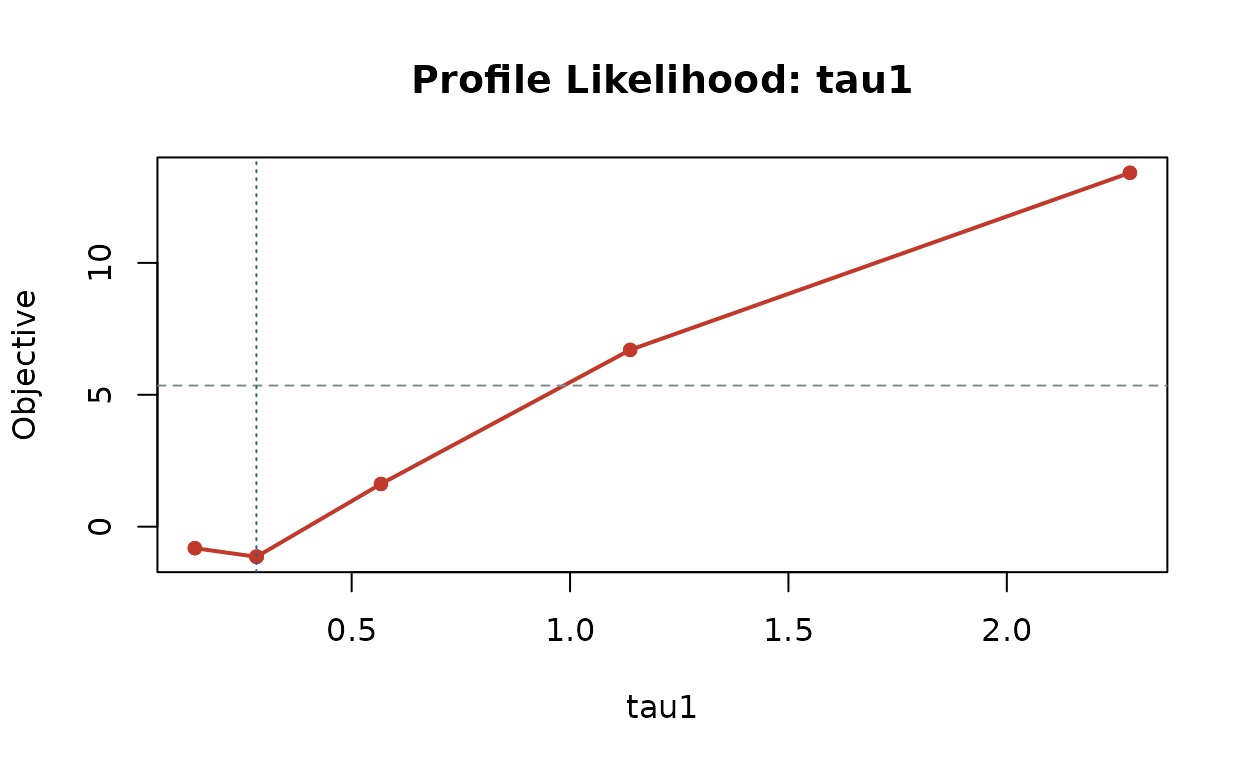
Custom Grids
For short vignettes, examples, or sensitivity checks, pass an explicit grid. Named grids are matched to the requested parameter names.
pr_grid <- profile_likelihood(
  fit_bcg,
  parameters = c("year", "tau1"),
  grid = list(
    year = c(-0.01, 0, 0.01),
    tau1 = c(0.1, 0.2, 0.3)
  )
)

pr_grid$summary
#>   parameter parameter_index           mle   cutoff ci_lower ci_upper
#> 1      year               2 -0.0003590629 5.349309       NA       NA
#> 2      tau1               3  0.2819106893 5.349309       NA       NA
pr_grid$profiles$tau1
#>   parameter parameter_index parameter_value  objective converged
#> 1      tau1               3             0.1  0.7020273      TRUE
#> 2      tau1               3             0.2 -1.4087885      TRUE
#> 3      tau1               3             0.3 -1.0108233      TRUE
Two-Dimensional Surfaces
Set parameter_pairs to request a two-dimensional profile
surface. The surface is a contour plot of the same deviance-scale
objective after fixing both parameters and re-optimizing the remaining
parameters. The example uses a very small grid for speed.
In the contour plot below, points near lower contour values are
better supported by the data. Moving outward from the minimum shows
combinations of year and tau1 that require a
worse model fit, even after the intercept is re-optimized.
pr_surface <- profile_likelihood(
  fit_bcg,
  parameters = c("year", "tau1"),
  parameter_pairs = list(c("year", "tau1")),
  n_points = 4,
  span = 2
)

names(pr_surface$surfaces)
#> [1] "year__tau1"
pr_surface$surfaces$year__tau1$parameters
#> [1] "year" "tau1"
dim(pr_surface$surfaces$year__tau1$objective)
#> [1] 5 5
Random-Effects Convenience Wrapper
profile_random_effects() is a focused wrapper for
variance-component profiles. It returns the same confidence-interval
summary idea, with profile data columns named around
tau.
pr_tau <- profile_random_effects(
  fit_bcg,
  tau_indices = 1,
  n_points = 5,
  span = 2
)

pr_tau$summary
#>   tau_index       mle   cutoff ci_lower  ci_upper
#> 1         1 0.2819107 5.349309       NA 0.9858376
pr_tau$profiles$tau1
#>   tau_index tau_value objective converged
#> 1         1 0.1409553 -0.814914      TRUE
#> 2         1 0.2819107 -1.142022      TRUE
#> 3         1 0.2827391 -1.136381      TRUE
#> 4         1 0.5671398  1.619323      TRUE
#> 5         1 1.1376125  6.701402      TRUE
#> 6         1 2.2819107 13.415105      TRUE
Use profile_likelihood() when you want fixed effects,
random effects, or 2D surfaces. Use
profile_random_effects() when you only need quick
random-effects profiles.